Pharrell Asked John Legend to Sing Less. “Muse” Is What Happened

John Legend built a career on the kind of voice that makes a room stop. For his new album, Pharrell Williams pushed him toward a more surprising move: stop proving the size of that voice on every line. Muse arrives October 23 with Pharrell producing the full project and encouraging Legend to lean into rhythm, conversation and restraint. The result is not a rejection of the singer people know. It is an attempt to make familiarity feel alive again.
Legend has described Pharrell’s direction as an invitation to “talk-sing” more, allowing the phrasing to sit inside the groove instead of placing every note at the center of the arrangement. That suggestion sounds small until it reaches a vocalist associated with piano ballads, clean belts and formal romantic songs. Singing less can be difficult when technical control has always been part of the promise.
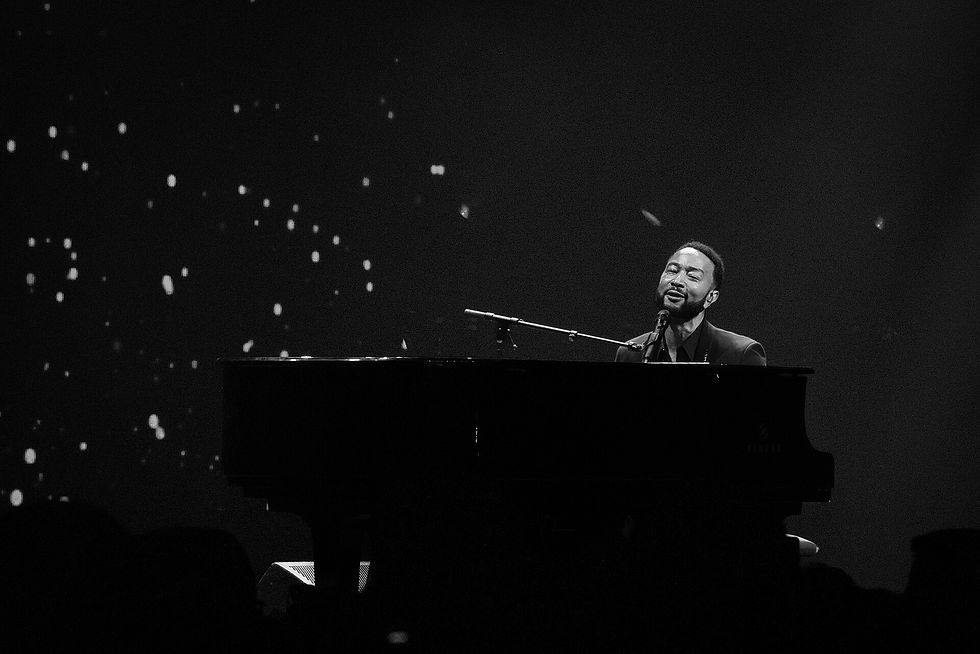
Muse puts John Legend’s famous voice inside Pharrell Williams’s tighter, more rhythmic production. Image: EGilham / Wikimedia Commons / CC BY-SA 4.0
The partnership works because Pharrell’s production has long depended on space. A clipped drum pattern, a bass line and one unusual texture can create more movement than a crowded arrangement. That space gives a singer choices. Legend can arrive slightly behind the beat, let a sentence land like dialogue or hold back the note an audience expects him to chase.
Muse was announced as a complete collaboration rather than a collection of unrelated sessions. Having one producer shape the full album matters in a streaming era that often treats albums as delivery systems for several possible singles. A consistent sonic language can make the quieter songs feel connected to the obvious hooks and give listeners a reason to experience the sequence rather than sample it.
Legend is not abandoning melody. His appeal has always come from combining gospel training, soul tradition and pop clarity. The change is in emphasis. A voice can communicate desire through a breath, a pause or a rougher edge as effectively as it can through a sustained note. Pharrell appears interested in the parts of Legend’s instrument that polish can sometimes hide.
That choice also fits an artist who no longer needs to introduce himself. More than two decades after Get Lifted, Legend has an EGOT, a catalog of wedding standards and enough television visibility to make his public identity feel fixed. A new album cannot simply announce that he sings beautifully. Listeners already know. Muse has to show what he can do when beauty is not the only objective.
The title suggests inspiration, but the project’s more interesting theme may be attention. Legend is listening to a producer who hears a different performer inside him. Pharrell is working with a singer whose strengths could easily overwhelm a beat. The creative tension comes from asking both artists to resist their most recognizable habits without losing the qualities that brought them together.
For fans, the test will be emotional rather than technical. A restrained vocal matters only if it brings the listener closer to the story. Talk-singing can sound intimate when it feels like a confidence offered across a room. It can also feel underwritten if the song has nothing worth saying. The production choice raises the stakes for the writing because there is less vocal spectacle available to cover a weak line.
The album arrives when R&B and pop are increasingly comfortable with understatement. Younger artists often move between singing, speech and melody without treating them as separate modes. Legend does not need to imitate that generation. He can draw on the same flexibility through the authority of his own voice and the lived experience behind it.
Muse will still contain the moments when John Legend opens up and reminds listeners why his voice became famous. The more revealing moments may be the ones just before that release. Pharrell’s challenge was not to make a great singer smaller. It was to make every choice audible. If the album works, the note Legend does not sing will carry as much feeling as the one he does.


Comments